
What brought you to astrology?
Being grounded! No seriously! My parents grounded me for months at the beginning of my sophomore year of high school. My German teacher, and incidentally a former WSAA president, Gary Lorentzen saw how upset I was about it and asked me about my birth data. The next day after class, he handed me a printout of my natal chart (which I still have!), suggested some books to get at Powell’s Books, and said if I have any questions about all of it, ask him after school. And so it began… Also, my computer also got taken away, so I had to learn how to do charts from scratch from day one. I didn’t use a computer to do charts until about a year later.
Who did you study astrology with?
After over a decade of study with Gary Lorentzen, I enrolled in Rod Suskin’s School of Astrology and spent 4 years in his three-year program. I loved it so much I repeated the third year! I also worked closely with Nicola Smuts-Allsop, learning her approach to fertility astrology and the medieval techniques associated with it. Between the three of them, I got a very grounded and well-rounded astrology.
What is your specialty, or focus?
Right now, my focus is less on a specific branch or facet of astrological practice and more on creating access to resources for the astrological community. Every day, I work on building the CAELi Institute, a real-world research center for astrology and astrologers in Olympia, Washington. I also serve on three boards. In 2024, I became the president of ISAR, which put me on the UAC board, to plan the amazing upcoming 2026 conference (I hope to see you all there!). I also serve as the Vice Chair of the Kepler Board, helping the mission to provide people with a robust college-level astrological education. When Maggie Nalbandian ran Astrology et al. (which is now over 50 years old!), she was known to say, “Let the people decide!” when it came to astrological approaches. I see my current work as carrying on her mission and helping astrologers find their home in the many ways we connect the stars with our lives.
What are your top 3 favorite astrology books?
This has to be a trick question! Who can pick just three? Actually, I ask guests on my podcast, Within Orb, this very question, and I’ve got 112 guests who have shared their answers. I appeared on episode 39, and claimed three books, but now some time has passed and I would probably pick three totally new ones… Right now I am intrigued by Cyril Fagan’s Astrological Origins for how it explodes your orientation to our field, Dusty Bunker’s book on Quintiles and Tredeciles (the latter being my favorite harmonic aspect!) because of her brilliant marriage of Egyptian cosmology, numerology, and the geometry of these aspects, and the book that started it all for me, Nick Campion’s The Great Year, which I am typesetting for Sophia Centre Press, a full Saturn cycle after reading it for the first time. If you like Cosmos and Psyche, you’ll fall in love with The Great Year.
If you could have dinner with any historical astrologer, who would it be?
One might expect me to say Elsbeth Ebertin, as you’ll see in my upcoming talk, I have done extensive work researching her life and contributions to astrology, but that wouldn’t be my answer today. I think I’d go back to antiquity and dine with Hypatia. There’s so much to learn about the life and perspectives of one of the earliest known women in our field.
Is there a planet, sign, or aspect you’ve been exploring lately that represents an archetype or energy that feels important to you right now?
Yes, my favorite harmonic aspect, the tredecile, or sesquiquintile, referenced above. It’s a 108-degree aspect that illustrates the creative contributions one makes given the legacy they inherit. For a fuller description, read Dusty Bunker’s book, which is available at CAELi!
Are there any additional comments you would like to make about your lecture?
One of the best ways to become a better astrologer is to learn more about the history of astrological practice and practitioners in both the distant and the recent past. While it has been trendy to explore the most ancient origins of our art, the birth of modern astrology in the 20th century has much more nuance than popular narratives reveal. People do not usually clamor to listen to a historical lecture, and yet, there’s so much tea (or juice, or whatever goss can be spilled), you’ll have a riveting time learning how much was different, and how much has stayed the same, only we think we’re doing something new… Much of what I have to share is stuck behind a language barrier, and I have spent a good portion of my life learning German to be able to bring this time period to life for people who will never learn German to read it for themselves.
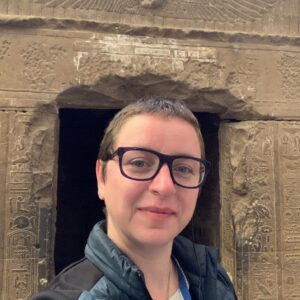
Jenn Zahrt PhD is an author, publisher, and teacher of cultural astronomy and astrology. She has taught and lectured domestically and internationally. She is the founder of Revelore Press, creative director of the Sophia Centre Press, and the founding director of the Celestial Arts Education Library in Olympia, WA, where she currently lives. She currently serves as the president of ISAR. Her first book Dialectique des étoiles Walter Benjamin et l’astrologie – a French translation of her PhD research on Walter Benjamin and astrology – launched in January 2025 in Paris and Brussels through Éditions Vues de l’esprit. Discover more of her work: www.jennzahrt.com and www.caeli.institute and https://www.vuesdelesprit.org/publication/dialectique-des-etoiles/